
The Rolex Hunters: Anatomy of the 2026 Cape Town Follow-Home Syndicate
Published: April 3, 2026 | Updated: June 2026 | Reading time: 9 minutes
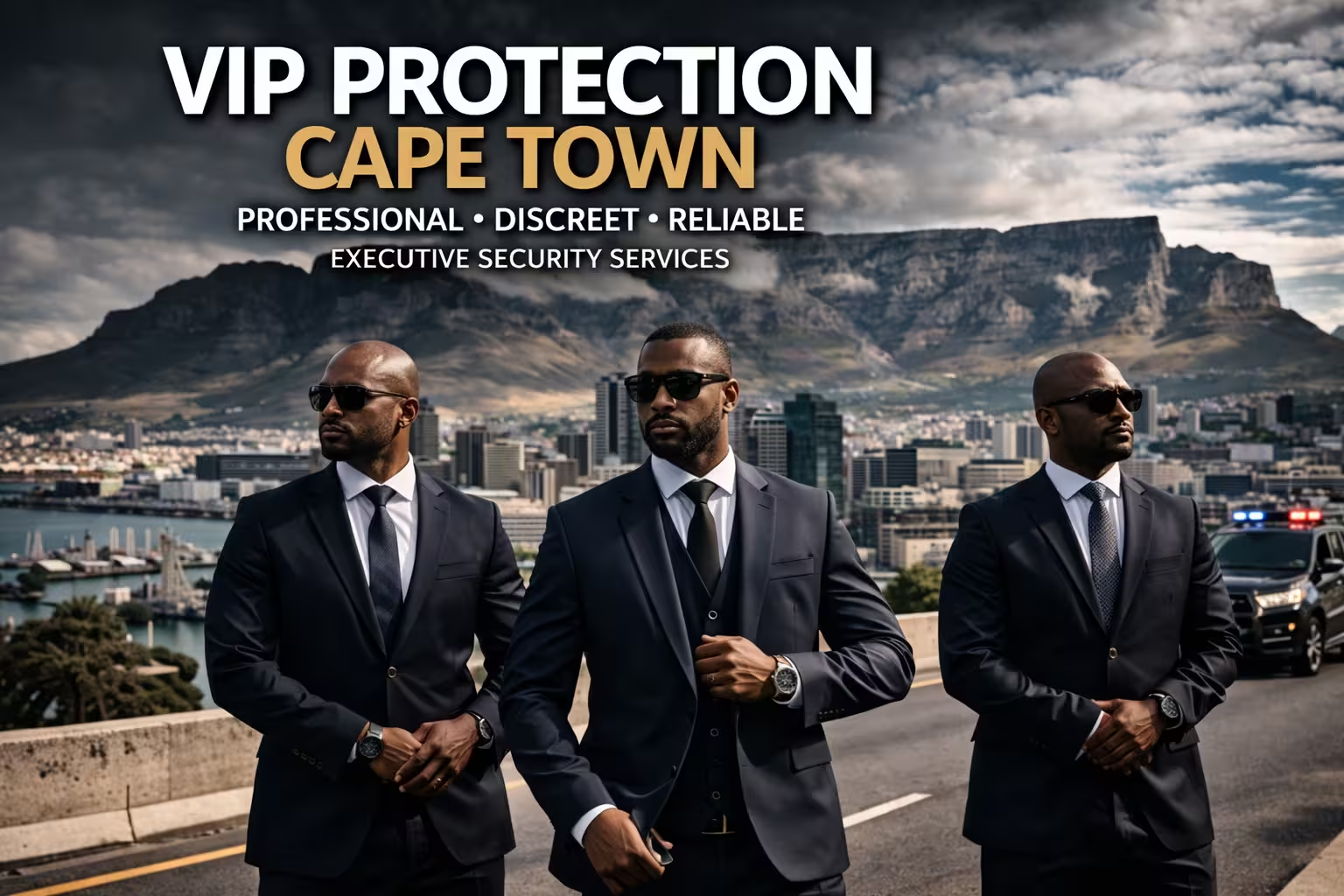
Why the Mother City's scenery hides a sophisticated predatory network — and why the people most at risk from the Rolex hunters are often the least aware of it.
There is a particular kind of confidence that expensive neighborhoods produce in people. The electric gate. The private security company decal on the gatehouse. The quiet, the trees, the absence of anything that looks like danger. Cape Town does this better than almost anywhere – the Atlantic Seaboard especially, where the combination of extraordinary scenery, carefully maintained streets, and the general weight of wealth creates an atmosphere that feels, in the most literal sense, safe.
That feeling is exactly what the Rolex hunters in Cape Town are counting on. For those requiring uncompromising VIP protection Cape Town, IPS provides the discreet, intelligence-led coverage that neutralises this threat before it materialises.
Rolex Hunters Cape Town: What the Statistics Show — and What They Hide
SAPS Quarter 4 statistics, released in February 2026, show a moderate decline in general carjacking figures in the Western Cape. That number has been picked up, reported on, and interpreted by multiple outlets as evidence that the security situation in Cape Town is improving. In a narrow, technical sense, they are not wrong. General carjackings – the opportunistic, high-volume, low-value incidents that dominate the aggregate statistics – have declined slightly.
What the aggregate figure obscures is the parallel, inverse trend in what analysts now categorise as targeted lifestyle robberies – the category the Rolex hunters of Cape Town occupy. This covers follow-home operations, luxury watch and asset targeting, and planned criminal operations against high-net-worth individuals. And it is moving in the opposite direction. Not slightly. Meaningfully.
The syndicates that have historically operated in this space have, over the past 18 to 24 months, upgraded their intelligence capabilities, their vehicle fleets, and their operational patience in ways the carjacking numbers simply don't capture.
International bodies tracking this trend, including ASIS International – the world's largest association of security management professionals – have flagged luxury-asset follow-home crime as a rising global pattern, with London, Paris and Cape Town repeatedly cited in the same analyses.
The people in this bracket are, by definition, a smaller target pool. But they are also the people for whom the consequences of an incident – financial, physical, psychological, reputational – are most severe and most lasting.
And they are, in the current Cape Town environment, increasingly the primary focus of the most sophisticated criminal operations running in the city. Private investigator intelligence confirms that these syndicates conduct weeks of surveillance before any action – a fact most corporate security plans ignore.
How the Rolex Hunters Hunt: From the Arrivals Hall to the Front Gate
Understanding the follow-home threat in Cape Town requires understanding that the process begins long before anyone is followed. The operation starts with observation, and the primary observation point is Cape Town International Airport.
The arrivals hall at CPT is, for the Rolex hunters, a functioning intelligence environment. The people working it are not the disheveled criminals of the popular imagination. They are presentable, patient, and practiced. They stand in the positions that blend – near the car rental desks, in the greeting area, at the edges of the luggage carousel. They are dressed, in most cases, indistinguishably from business travelers or transport company representatives.
What they are doing, with considerable precision, is assessing. The Patek Philippe or Rolex on the wrist. The quality and brand of the carry-on luggage. The laptop bag that costs more than most people earn in a month.
Whether someone is met by a private driver and what the vehicle is. Whether someone heads to the premium rental counter and which vehicle category they select. Whether they are relaxed and familiar with the airport – a regular – or slightly disorientated in the way that first-time high-value visitors sometimes are.
This is not casual observation. It is structured intelligence gathering, and the output of it is relayed to a second team before the target has reached their vehicle.
The second team is already positioned. Not at the airport itself – that draws attention – but on the routes a city-bound traveler will take: the N2 corridor toward the Southern Suburbs and Constantia Valley, or the coastal approaches toward Blouberg, Table View and the Atlantic Seaboard.
These teams know the routes because the routes are not complicated. Cape Town's geography – hemmed by the mountain and the ocean – creates a relatively limited number of logical paths between the airport and the city's wealthiest residential areas. The Rolex hunters have mapped those paths, identified the vulnerability windows along them, and positioned accordingly.
The follow begins in traffic, where it is invisible. A high-performance vehicle with false plates, sometimes two of them operating in rotation so no single car is visible behind the target for an extended period.
By the time the target turns into their street in Constantia or their complex in Camps Bay, the team knows exactly where they are going. The vulnerability window – the 20 to 30 seconds it takes for a residential gate to open and close – is the moment they have been building toward since the arrivals hall.
IPS's VIP protection services neutralise this timeline by eliminating the airport exposure, deploying counter-surveillance driving, and pre-clearing every route before movement.
The Watch Is the Beacon: What the Rolex Hunters Are Actually Tracking
It is worth being specific about why the luxury watch sits at the centre of this crime category. A Rolex Daytona, a Patek Philippe Nautilus, an Audemars Piguet Royal Oak – these are not just expensive objects. They are compact, instantly identifiable from metres away, effectively untraceable once moved offshore, and convertible to cash within days through established grey-market channels.
The stolen-watch economy is large enough that The Watch Register, the international database used by dealers and law enforcement, now lists over 100,000 lost and stolen timepieces – a figure that has grown sharply year on year.
For the Rolex hunters of Cape Town, the watch performs a second function: it is the qualifying signal.
A R400,000 watch on a wrist in the arrivals hall tells a spotter everything they need to know about the probable value of the luggage, the rental car category, the accommodation, and the contents of the home the target will eventually lead them to. Wearing it through a public airport is, in operational terms, broadcasting.
The behavioural adjustments are simple – travel with the watch in carry-on, wear it only at destination, rotate to a low-signal piece for transit days – but they only matter if the rest of the movement plan is equally disciplined. A clean wrist with a predictable route is still a target.
Why Affluent Suburbs Attract the Rolex Hunters – Not Repel Them
This is the counterintuitive reality that many high-net-worth individuals in Cape Town have not fully absorbed: the neighborhood they chose for its safety is, in the calculus of these syndicates, part of the reason they were targeted.
The follow-home syndicates operating in the Constantia Valley, in Bishopscourt, in the Atlantic Seaboard villages of Clifton and Camps Bay, and in the Winelands access routes, are not there despite the affluence. They are there because of it.
Quiet streets mean fewer witnesses. Well-maintained roads mean faster approach and exit routes. Residential security designed to keep out casual intruders is, in most cases, not designed to respond to a coordinated, high-speed, multiple-vehicle operation conducted by people who have observed the security protocols in advance and planned around them.
The gate that makes a resident feel safe gives the syndicate a predictable window. The estate guarding contract runs on a rotation – and rotations, once observed over several days, become predictable.
(What a properly structured and supervised guarding deployment costs, and why the cheap ones are the predictable ones, is covered in our security guards prices guide.) The domestic staff arrival and departure times create consistent points of reduced vigilance.
None of this is paranoia. It is the documented methodology of operations that have been investigated and in some cases prosecuted across the Western Cape over the past 24 months.
The Winelands Corridor: The Rolex Hunters' Newest Territory
One development worth examining specifically is the expansion of sophisticated targeting into the Winelands corridor – Stellenbosch, Franschhoek, and the R45 and R310 routes that connect these areas to the city.
The Winelands has historically occupied a different threat category to the Cape Town CBD and its immediate surrounds. The perception of it as a genteel, pastoral environment – international visitors at wine estates, private villa stays, farm-to-table restaurants – created a security blind spot that has been exploited with increasing frequency since late 2024.
The profile of the visitor using this corridor is almost designed for targeting: international, high-net-worth, often unfamiliar with local routes, frequently in unfamiliar rental vehicles, and moving between multiple destinations in a single day on a schedule a patient observer can anticipate.
The distances involved – 40 to 60 kilometres from the city centre – create isolated stretches of road between the estate exit and the highway that offer exactly the kind of reduced-witness environment these operations prefer.
This is not theoretical. We have specific, documented intelligence on syndicate positioning on routes between the Franschhoek valley and the N1 interchange, and on the Stellenbosch R44 approaches. If your guests, clients, or family are using this corridor without a counter-surveillance capability running alongside them, the exposure window is real.
Beating the Rolex Hunters: The IPS Cape Town Protective Envelope
The term "protective envelope" is used deliberately. A bodyguard accompanying someone to a restaurant is not a protective envelope. It is a visible deterrent at best, and in many cases in Cape Town it is a visible signal that the person being accompanied is worth targeting by other means at other times.
(The distinction between a visible bodyguard and a structured close protection detail – and what each actually costs – is unpacked in our bodyguard services overview and our VIP protection cost guide.)
Genuine protective coverage in this environment works differently. It starts earlier, extends further, and operates in ways that are largely invisible to everyone, including the threat.
- Airport tarmac transfers. The arrivals hall vulnerability – the point at which the Rolex hunters make their targeting decisions – is eliminated by moving principals through channels that do not expose them to the general arrivals environment. Pre-cleared, pre-positioned, with a known and verified vehicle waiting in a location that is not the standard rental or taxi rank. The spotter in the arrivals hall is looking for someone who never appeared.
- Counter-surveillance sweeps. Before a client moves to a restaurant in the Winelands, a villa in Camps Bay, or a meeting in the Stellenbosch corporate park, our advance team has already been on that route. Not a GPS check – a physical drive, looking for static vehicle positioning, for the specific indicators of syndicate pre-positioning that are invisible to the untrained eye and obvious to someone who has spent years learning what to look for. If the environment is clean, the principal moves. If it isn't, the movement is adjusted before any exposure occurs.
- Anti-follow driving capability. Our close protection officers operating in Cape Town are trained in counter-surveillance driving – not evasive driving in the cinematic sense, but the disciplined, systematic monitoring of the vehicle bubble that detects a follow in its early stages, when the options for response are widest. A follow identified 8 kilometres from the target location is a very different situation to one identified at the gate. We aim, consistently, to be the former.
- Accommodation and venue security assessment. The private villa in Clifton, the boutique hotel in Franschhoek, the wine estate guesthouse in Paarl – each presents a specific security profile that needs to be understood before a client occupies it. We conduct pre-arrival assessments, identify access points, staff schedules, and gate and perimeter characteristics, and brief the client on the specific behavioural adjustments the venue warrants. Not to create anxiety. To eliminate the surprises that create vulnerability.
- Residential hardening. For residents rather than visitors, the protective envelope extends to the home itself – gate discipline protocols, lighting and camera positioning reviewed against actual syndicate approach methodology, and where the property profile justifies it, a dedicated guarding post structured to be unpredictable rather than ornamental.
The Visitor Who Doesn't Know the Rolex Hunters Exist
One final point that I think matters more than any of the tactical detail above.
The majority of follow-home incidents in Cape Town in 2025 and into 2026 have involved people who, when interviewed afterward, said some version of the same thing: they didn't know they were at risk. Not because they were naive – these are intelligent, experienced people. But because the threat model most people carry for Cape Town is calibrated to a different era and a different type of crime.
The Rolex gangs of popular imagination are a smash-and-grab proposition. What's operating in Cape Town now is a patient, observational, intelligence-driven criminal enterprise that selects its targets methodically and acts at a time and place of its own choosing.
The threat is invisible right up until it isn't. And by the time it isn't, the tactical situation has already shifted against anyone who isn't prepared.
In 2026, visiting Cape Town or living in it as a high-profile individual means operating in an environment where your security posture needs to be as considered and as sophisticated as the people who are potentially assessing you.
That is not a comfortable thing to say. It is, however, an accurate one.
Intelligence Protection Services operates a full VIP protection capability in Cape Town, covering airport transfers, close protection, counter-surveillance, Winelands corridor coverage, and residential security assessment across the Western Cape – with the same protective envelope available through our VIP protection services in Johannesburg, Pretoria and Durban.
Protect What Matters Most
Whether you are a resident, a frequent visitor, or an organisation operating in Cape Town, IPS provides the intelligence-led protection that the current threat environment demands.
Your first consultation is confidential and obligation-free.
Request a Confidential ConsultationFor residents, visitors, and organisations operating in Cape Town who would like to understand the current threat picture in more detail before they need to for a different reason – the conversation is free, confidential, and available at any time.